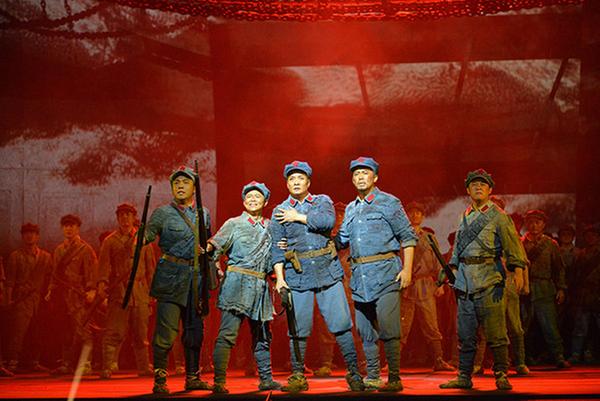
Opera 'Long March'
Overview
The opera Long March is a significant cultural production that commemorates a pivotal historical event in Chinese history—the Long March undertaken by the Red Army.
On July 1, 2016, the opera Long March made its debut at the National Center for the Performing Arts in Beijing. And, on the same day, a year later, the opera premiered as a movie production at the NCPA, marking the 96th anniversary of the founding of the Communist Party of China.
Historical Context and Creation
The Long March was a military retreat conducted by the Red Army to evade the Kuomintang forces. It spanned from 1934 to 1936 and covered over 9,000 kilometers.
This opera was staged to commemorate the 80th anniversary of the Long March and captures key events from this epic journey, such as the battle near the Xiangjiang River and the crossing of Luding Bridge. The libretto was crafted by the renowned Chinese scriptwriter Zou Jingzhi, taking four years to complete, highlighting the opera's dedication to historical accuracy and depth of narrative.
Music and Performance
The composition of the Long March Opera was undertaken by Yin Qing, who spent two years melding Western opera techniques with traditional Chinese folk elements. Yin's composition is noted for its integration of bel canto singing with Chinese folk music, a blend that aims to convey the spirit and culture of the Long March era.
The opera features powerful performances by prominent tenors such as Yan Weiwen and Wang Hongwei, who portray the roles of Commander Peng and the young soldier Ping Yazi, respectively. Their performances are integral to bringing the characters' sacrifices and bravery to life, engaging the audience in the historical narrative.
Technical and Artistic Innovation
The movie adaptation of the opera Long March employs cutting-edge Ultra HD, or 4K technology, to provide a highly detailed visual experience. Hou Keming, the film's director, utilized this technology to enhance the cinematic portrayal of the opera, ensuring that the audience experiences the grandeur and intensity of the Long March.
The stage design, crafted by architect Ma Yansong, known for iconic structures such as the Absolute Towers in Canada, integrates multimedia technology to create immersive scenes. The choreography, directed by Yang Xiaoyang, vice-president of the Chinese Dancers Association, adds dynamic elements to the battle scenes and depictions of the diverse landscapes encountered during the Long March.
Cultural Significance
The opera Long March not only serves as a tribute to a crucial chapter in Chinese history but also exemplifies the fusion of Eastern and Western artistic traditions. By utilizing a Western art form to tell a distinctly Chinese story, the opera bridges cultural divides and highlights the universal themes of sacrifice, perseverance and heroism. Article reference1. Immortalized on film. chinadaily.com.cn. 2017Photo Gallery(3 pictures)CategoriesArtsTagOpera and DramaModern and Contemporary Chinese HistoryCatalogue1. Overview2. Historical Context and Creation3. Music and Performance4. Technical and Artistic Innovation5. Cultural Significance- - - []








